
AIAP members visit JKUAT Innovations in Urban Agriculture and Water Saving Techniques
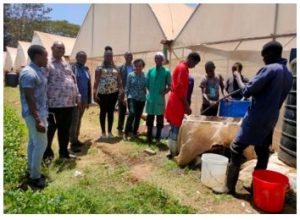
AIAP members during the field visit at JKUAT farm Block A
On the 10th of February 2023, a group of AIAP members visited Jomo Kenyatta University of Agriculture and Technology (JKUAT) to learn
innovations in urban agriculture and water saving irrigation techniques. The team was hosted by Prof. John Wesonga -of- Horticulture Department. Objectives of the field visit was to gain practical skills in urban agriculture that address societal challenges that included unemployment, climate change and food and nutrition
Innovations
This corner of JKUAT farm is dedicated to horticultural experimentation conducted by students and staff, within green houses and also in the open field. The underlying innovation across the entire place, was adoption of capillary wick irrigation systems, which are more water saving and efficient than traditional drip irrigation.
Within green houses, clean sanitary conditions are maintained where succulent strawberies are grown in trays fitted with the self-wicking beds. Home-made moist beds for tomato, are another innovation so as to make use of local materials.
Other innovations included doing nursery for single node napier grass, and planting the same napier on self-wicking beds. Even dragon fruit nursery was thriving under the system.
The outdoor gardes were a marvel of different design for using little spaces to grow more, including a wall garden, vertical gardens, moist beds made from packing crates, basins or other artifacts, all growing a myriad of vegetables from kales, spinach, lettuce, Chinese cabbage and traditional vegetables such as black nightshade (managu), amaranth (terere) and sweet potatoes among others
Perhaps the show-stopper was the production of micro-green, utilizing lunch boxes, the same capillary wick system and taking up very little space. Micro-greens is a crop everyone could grow, even on a window-sil. These crops are a revolution in terms of nutrient content and quick turnover as it takes 14-21 days, and they fetch a high price in iniche markets.
The passion of prof. Wesonga and his dedication to ingenious, yet simple ways to address water and horticultural innovations is at another level. His love for his students and encouragement is such that he has helped many of them start off businesses on graduation.
There was also use submersible pumps connected to an automated power system that irrigates the greenhouses 3 times a day for 3 mins through drip irrigation.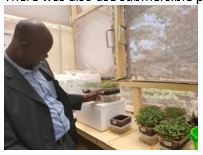
They also have an underground silo where fertilizer is mixed and is connected to the water pumps. Fertigation is continuous but for 1 minute.
Notes on Innovations and Activities
1. Self-wicking beds and capillary wick system
These are water saving techniques that require use of capillary mat system to help propagate water usage and labor costs.
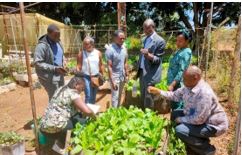
Styrofoam boxes, containers or soil blocs are mostly used for these techniques. The system requires no pumping or very minimal use of energy.
The capillary mat is usually polyester to enable easy absorption of water. The system has 2 chambers; i) Top chamber for plants i.e. strawberries or tomatoes, ii) bottom chamber for the capillary wick.
2. Single node sweet potato seedlings
Here, a sweet potato cutting that has leaf nodes is planted in some trays that have wick mats under.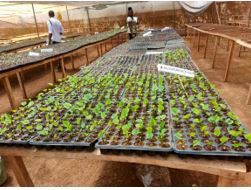 As the plant grows, roots develop from every leaf node of the cuttings made. It takes 3-4 weeks before the seedlings can be transferred to the main farm.
3. Dragon Fruit
These are highly valued crops that are also highly nutritious. They easily adapt to dry conditions and are therefore ideal for production under the changing climate.